Pigeon Recovery, Sick birds, Pigeon Rescue, Pigeon Welfare
 PIGEON RECOVERY PIGEON RECOVERY
If you see a sick or injured bird on or near the Square, or anywhere else, the best thing you can do is take the bird to Pigeon
Recovery, an excellent sanctuary where the birds are assured of the best
possible treatment. They are at:
8 Vermont Road
Sutton
Surrey SM1 3EQ
[Map Link]
If there is no-one in, facilities exist outside the front door for leaving
poorly pigeons, and the sanctuary owners are never away overnight. If at all
possible, a small contribution posted through the letterbox when you leave
the bird(s) would go towards paying for the bird’s treatment, food etc.
Of course, it may be that you can’t get to Pigeon Recovery in which case,
depending on what is wrong with the bird, you may need to attempt first aid
or take it to a professional. If a bird is found in Trafalgar Square, and
there is no way you can get it to Pigeon Recovery, please take it home with you and EMAIL US with details of where you are located. We will email you back as quickly as possible with the best way of helping you and your bird. If the matter is urgent please also include a contact number.
 If taking a bird to a professional becomes necessary, please be very careful
where you take your patient. Make absolutely sure you know what will happen
to your bird as sadly many "professionals" will automatically put the pigeon to sleep irrespective of what is wrong with it. If taking a bird to a professional becomes necessary, please be very careful
where you take your patient. Make absolutely sure you know what will happen
to your bird as sadly many "professionals" will automatically put the pigeon to sleep irrespective of what is wrong with it.
FIRST AID
If first aid is an option, we offer some basic tips below, but strongly recommend you visit the following sites for more information and advice:
www.pigeon-life.net
This is an extremely useful resource. You’ll need to register, but this is free, simple and takes seconds. Click the “member exchange” button. You can then post a question, outlining the problem in as much detail as possible (if you can upload a picture, so much the better), and ask for advice. With over 5,000 members, the chances are you’ll be inundated with helpful, friendly advice within minutes.
Austin Duck Police
Don’t ask, we didn’t come up with the name! Located at www.duckpolice.org, this superb site contains invaluable information on everything from hand rearing a baby and emergency feeding  techniques to fixing broken wings and legs. techniques to fixing broken wings and legs.
Basic Tips
If the breast bone is protruding, the plumage is poor and the bird seems weak, it may be malnourished. Such birds should, of course, be fed as soon as possible, preferably with smaller seeds as well as mixed corn, as these are easier to digest.
Dehydration may occur, especially in summer conditions. A suitable solution
to give to a pigeon – held to the beak, not forced down the throat – is the
following:-
1 tablespoon of sugar
1 teaspoonful of salt
dissolved in one litre of water, offered frequently. “Flat” soft drinks may
be used in an emergency.
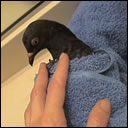 Twine around the feet is often encountered. Sharp nail scissors can usually
remove very loose twine and the birds can afterwards be released, but if
there is skin damage, loss of toes etc, an antiseptic spray from any chemist
should be applied and professional help sought. You may want to invest in a
pair of suture scissors (click here for a supplier) that are ideally suited for effective, safe twine removal. Twine around the feet is often encountered. Sharp nail scissors can usually
remove very loose twine and the birds can afterwards be released, but if
there is skin damage, loss of toes etc, an antiseptic spray from any chemist
should be applied and professional help sought. You may want to invest in a
pair of suture scissors (click here for a supplier) that are ideally suited for effective, safe twine removal.
If signs of infection are
present such as discharge or an offensive smell, on feet or around the beak
and eyes, the pigeon will need antibiotics as soon as possible. Broken wings
and legs are treatable – do not let anyone talk you into “putting down” such
a bird. They will, however, require treatment by a sympathetic vet or Pigeon
Recovery.
Pigeons which seem unreleasable, too, such as those who are blind, lame,
disorientated or in any way disabled, should not be destroyed – they are
assured of a place in Pigeon Recovery’s garden sanctuary.
If you are in possession of such a bird email us and we’ll get back to you
as soon as we can.
CAT ATTACK
Typical injuries are scratches or holes under the wing or on the back with considerable feather loss. In all cases antibiotics from a vet are necessary since cats' teeth carry bacteria. Clean the wounds with TCP, saline solution or antiseptic spray. Warmth and quiet are essential before seeking professional advice. Email us for a rescue centre/wildlife hospital near to you.
VULNERABLE BIRDS
If you see a pigeon on it's own, on the ground or huddled up against a wall then there IS a problem. It could be a youngster who has fluttered down or fallen from a nest and cannot fly back. The parents are unable to help a young bird in this situation to get back to the nest. Or it could be a sick or injured bird. Please do pick it up and take it inside, put it in a box (or cat carrier) with food and water and email us.
PIGEON PAGES
You will see details of Pigeon Pages on our Merchandise page. This is an extremely helpful guide containing a lot of information about the history of pigeons but also giving advice on what to do if you find a baby, sick or injured pigeon and how to care for it until you can get help. It is written and illustrated by the ladies who run Pigeon Recovery in Sutton and who have been involved with caring for pigeons for many, many years. |















